


Marcel Wanders rose to international attention in the mid-1990s by blending theatrical storytelling with clever material experiments. The Knotted Chair (1995–96) became his breakout work: a piece that visually feels handmade yet relies on high-tech fibres and resin to become a real, sit-able object.
Product snapshot — what the Knotted Chair actually is
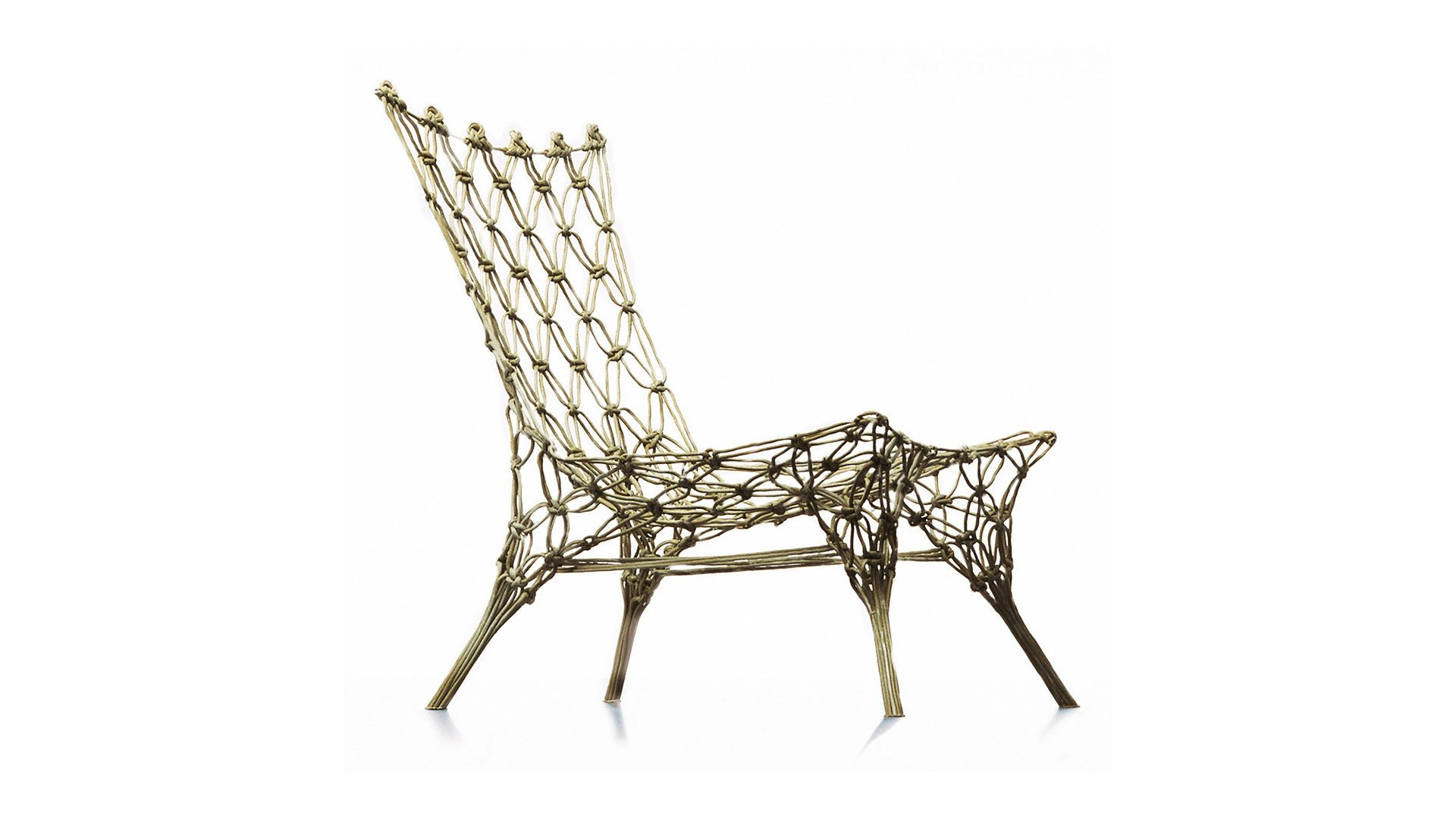
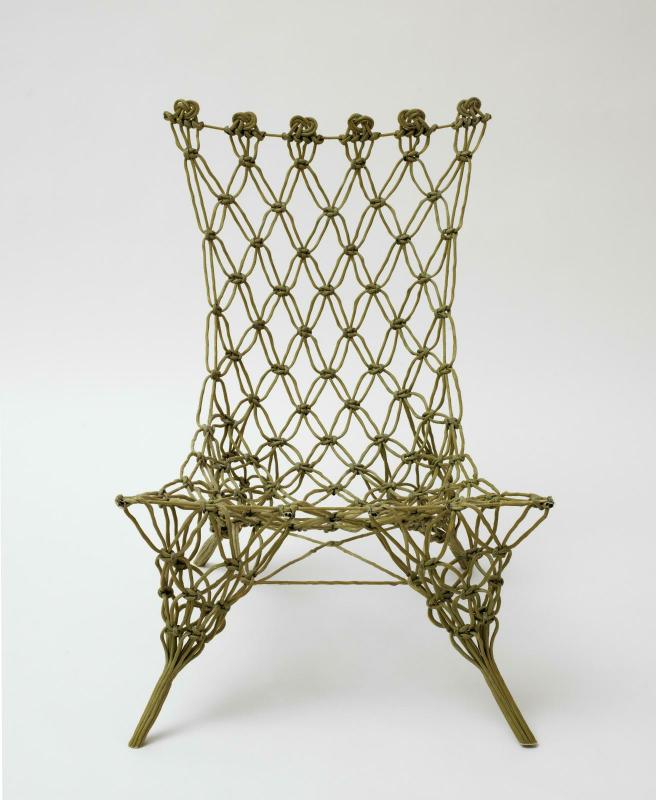
The Knotted Chair is a lightweight, sculptural armchair formed from a braided core of carbon/aramid fibre that is knotted or macramé-worked, impregnated with epoxy or resin, and hung to cure so gravity helps define the final shell. The result reads as an airy textile-like seat but performs structurally like a conventional chair. It was created for Droog’s Dry Tech project and quickly entered museum collections and limited production runs.
Why the idea mattered — craft meets technology
What made the Knotted Chair revolutionary was its reversal of the usual hierarchy between craft and industry: Wanders used age-old knotting techniques (macramé) as the shaping method, but fused them with aviation-grade fibres and modern resins to produce a structurally sound piece. That tension — the warm tactility of knots against cold advanced composites — reframed how design could be both human and technical.
Designer mindset — narrative, tactility and surprise
Wanders wanted a product that “didn’t look industrial” but still benefitted from industrial materials and precision. His brief was curatorial and poetic: give an object the aura of something made by hand for a single person, while using engineering to make it durable and reproducible. This mindset produced objects that read as stories (a knotted hammock made permanent) rather than as straightforward manufactured furniture.

From experiment to finished object — the development path
The Knotted Chair’s development was highly experimental and collaborative:
Research & brief: part of Droog’s Dry Tech initiative, which paired designers with technical labs to explore new material possibilities.
Material trials: teams tested braided aramid/carbon cords for tensile behavior and compatibility with epoxy impregnation to avoid brittle failure.
Formwork & gravity-shaping: the knotted shell was suspended in a frame and left to cure so gravity would help create the organic silhouette — a key move that let the process determine the final form.
Prototyping & testing: prototypes were load-tested for safety and comfort; the technique required careful heat-management and control of resin cure to produce consistent results.
Limited production: Cappellini and other manufacturers produced limited editions, followed by small runs and museum editions as demand and feasibility aligned.
This loop — craft experiment → technical collaboration → prototype → limited production — is the story of how the Knotted Chair moved from concept to icon.
Technical highlights — materials and making
Practically, the chair uses a braided aramid/carbon fibre cord that is knotted around an armature or simply formed by hand, then impregnated with epoxy resin. Once cured, the shell is rigid; the carbon core supplies tensile strength while the resin bonds strands into a unified shell. The technique produces a near-transparent, lace-like surface that still meets functional loads for seating. Weight, finish and edge treatment were refined during prototyping to ensure comfort and durability.
Cultural reception and accolades
The Knotted Chair became emblematic of Droog’s experimental era and of Wanders’ emergent voice: it won early critical acclaim, helped secure Wanders’ place in international design discourse, and contributed to awards and recognitions in the late 1990s. The piece now sits in major museum collections (MoMA, the Art Institute, V&A and others) and is widely cited in design histories as a turning point for craft-meets-tech approaches.
Manufacturing & commercial life — the practical side
Because the Knotted Chair’s making process is labour-intensive and material-sensitive, it was produced in limited editions rather than high-volume runs. Cappellini produced authorized editions, and in later years the design moved into special collections and miniatures (e.g., Vitra) — formats that preserve the object’s aura while making it accessible to collectors and museums. This production strategy kept the design exclusive and preserved its craft-like story.
Why it still matters — lessons for designers
Process as form-maker: let manufacturing method and curing behavior shape the final silhouette.
Marry opposites: combining craft techniques with advanced materials creates novel tactile narratives.
Prototype with real materials: working with the actual fibres and resins early prevents late surprises.
Positioning matters: limited production and museum placement can amplify cultural status without compromising craft values.
The Knotted Chair remains a vivid case study for studios that want to fuse storytelling with technical innovation.