


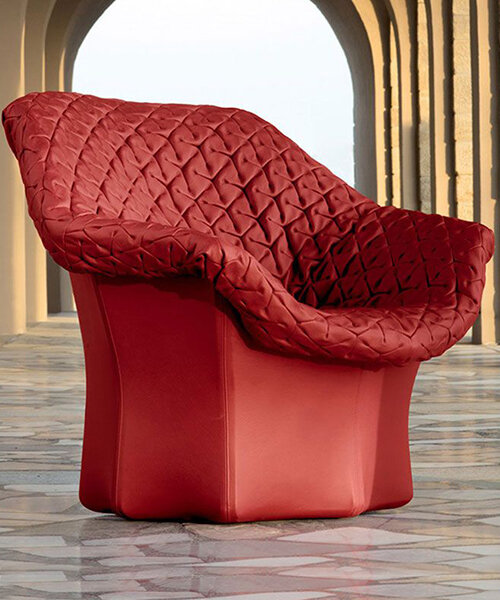
The Juliet armchair reads like a small costume piece for an interior — sumptuous, slightly theatrical, and quietly clever. Designed by Benjamin Hubert as the winning entry for Poltrona Frau’s centenary competition, Juliet translates a Renaissance fashion detail (the Juliet sleeve) into a contemporary upholstered object: a tight-fitting arm that blooms into a generous, pleated shoulder. The result feels both familiar and surprising — a chair that wears a story.

Why Juliet matters
Juliet matters because it’s not just a pretty seat; it’s a design that connects craft, brand heritage and contemporary production logic. Hubert respected Poltrona Frau’s leather tradition while introducing a novel construction language: leather is stretched and stitched into a triangular pleat system that reveals the timber framework beneath. That visible construction becomes the design’s voice — honesty about structure turned into ornament. The chair’s success lies in that balanced tension between narrative and manufacturability.
Designer mindset — storytelling through material and process
Hubert’s approach to Juliet started with empathy for heritage and an instinct for material expression. He didn’t begin by sketching a silhouette and dressing it; he began with the detail — the sleeve — and let that small formal language scale up into a whole object. His studio’s wider practice (now operating as Layer) often foregrounds process and materiality as design language, and Juliet is a clear early example: the design celebrates how something is made as much as how it looks.

From brief to concept — the centenary challenge
Poltrona Frau invited twelve designers to imagine a piece that could symbolise the brand’s first hundred years while projecting its values into the future. Hubert’s brief was therefore twofold: respect the brand’s leather craft and propose a new formal language that could be scaled for production. The idea of the Juliet sleeve offered a perfect bridge — culturally resonant, materially legible, and flexible enough to become a family of seats.
Design development — rules, pleats and frames
Juliet’s development is a lesson in rule-based design. Hubert and his team distilled the sleeve into a set of constructive moves: triangular pleats, tensioned leather surfaces, and a timber subframe that peeks through. Early studies explored pleat geometry and spacing; small maquettes established scale, then larger full-size mock-ups tested how leather behaved when stretched over the frame. The team paid particular attention to how seams and stitch lines would read as both detail and structural seam, turning what could be a hidden assembly into a visible, repeating motif.
Materials and craft — leather, timber and the art of tension
Material choices are central to Juliet’s personality. Poltrona Frau’s heritage in fine leather meant the chair needed to perform technically (tensile strength, wear resistance) and aesthetically (finish, patina). Hubert used leather’s flexibility and tensile qualities deliberately: when tensioned into pleats, leather both sculpts the volume and exposes the rhythm of the underlying wood frame. Timber was chosen and detailed to provide the correct geometry for the leather to sit against, while stitching and triangular panels controlled the visual rhythm. This is craft that reads as intentional, not ornamental.
Prototyping and testing — scales of truth
Turning a pleated sleeve concept into a comfortable armchair required iterative testing at multiple scales. Small paper and fabric maquettes helped define pleat angles; foam and clay full-scale studies revealed human-scale proportions; then leather-covered prototypes tested seating ergonomics, tension behavior over time and how pleats softened after use. Each prototype revealed small but crucial adjustments — a slightly different stitch allowance, a minute change in pleat depth — that cumulatively made the final product both convincing and comfortable.

Manufacture and feasibility — from atelier to production
One of Juliet’s strengths is its producibility: Hubert designed the construction to be translated into repeatable workshop and factory processes without losing its handcrafted aura. Leather panels are cut and stitched to a template; frames are milled to precise tolerances; and assembly sequences are choreographed so that tensioning the skin becomes part of the final finishing step. The visible seams and pleats are therefore not fragile flourishes but engineered details that can be reliably reproduced at scale.
Awards, launch and reception
Unveiled during Milan Design Week, Juliet won Poltrona Frau’s centenary competition and quickly became a headline piece — praised by design press and selected for special exhibitions. The chair’s narrative (Renaissance sleeve → modern seat), its dedication to leather craft, and its technical clarity made it a favourite among critics and specifiers. The press coverage helped position Hubert as a designer who could dialogue respectfully with heritage brands while offering contemporary gestures.
Design takeaways — lessons from Juliet
Start with a detail, not a silhouette. Small cultural motifs can scale into full products.
Make construction legible. Visible assembly can become a language, not a flaw.
Prototype across scales. Materials reveal their truth at full human scale.
Design for production from day one. Crafty looks must be engineered to hold up in repeatable manufacture.
Tell the story. Heritage brands reward thoughtful narratives that connect past and future.
Official links for further reading:
https://www.designboom.com/design/benjamin-hubert-juliet-poltrona-frau-centenary-armchair/
https://www.itsnicethat.com/articles/benjamin-hubert-juliet-chair
https://chairblog.eu/2012/05/02/juliet-by-benjamin-hubert-for-poltrona-frau-the-chair-the-making-of/
https://www.pamono.eu/italian-juliet-armchairs-by-benjamin-hubert-for-poltrona-frau