


Armaghan Ahmadi is an Iranian lighting designer whose work has attracted attention through competitions and jury invitations. She is listed among the lighting designers on the Kioskedia jury roster, and her project Black Eye received recognition in the Lighting Product category from Kioskedia. Her design practice often explores poetic metaphors and spatial light effects rather than simply servicing function.
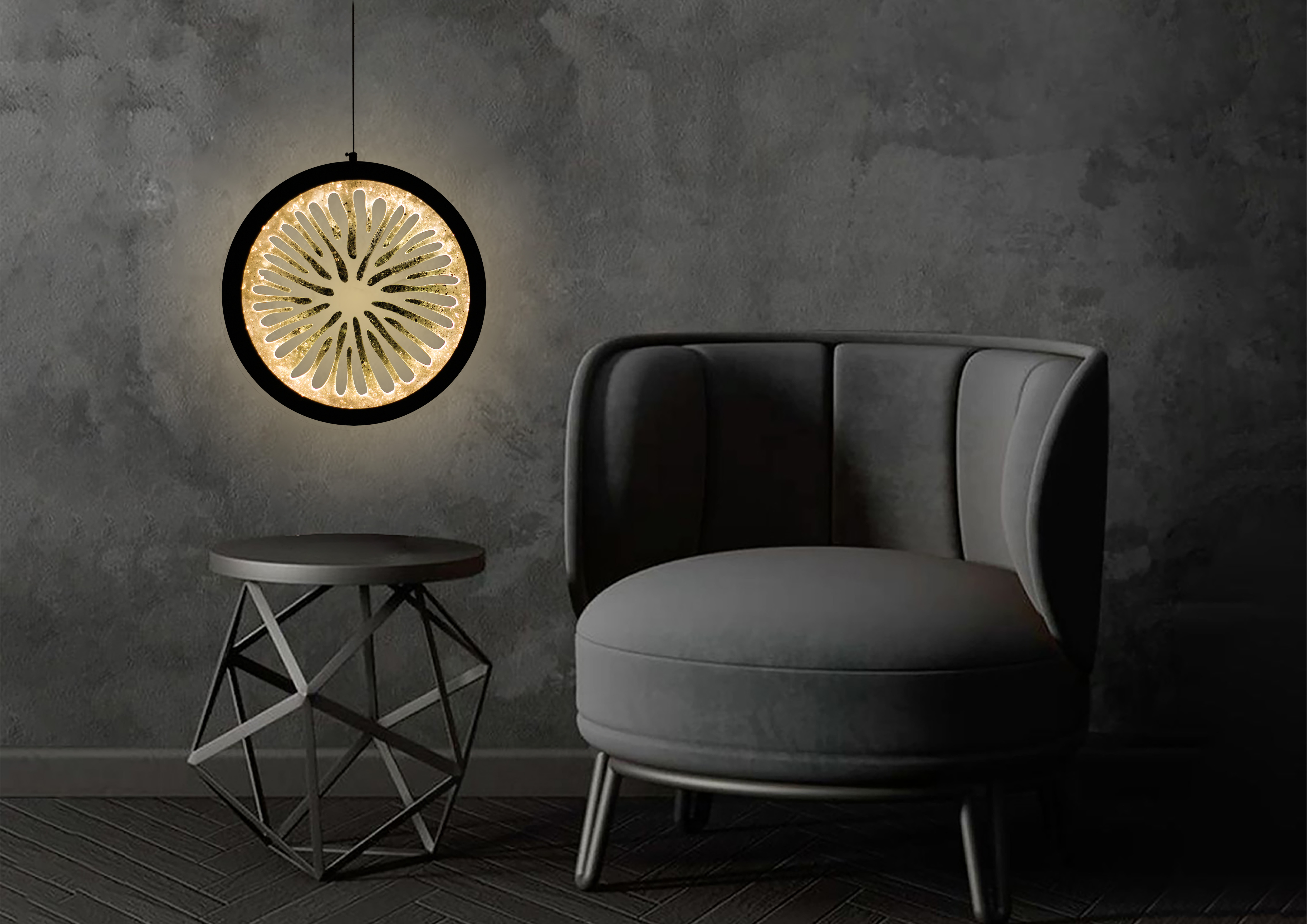
Product snapshot — what *Black Eye* is
Black Eye is a lighting fixture inspired by the structure of galaxies. The design seeks to evoke space, radial symmetry and star paths — as if the light object houses the eye of a galaxy. The lamp is positioned so that its form and lumen distribution recall cosmic aesthetics: round, central, radiating. It was awarded an Honorable Mention in Kioskedia’s Lighting Product category in 2024.
Why the concept matters — light as cosmic metaphor
Black Eye matters because it translates an abstract celestial metaphor into an object of everyday scale. Rather than decoration by illustration, the design uses geometry, reflection and controlled light output to evoke the cosmic. That poetic dimension helps the lamp become more than a lighting appliance — it becomes a narrative piece, triggering associations with astronomy, scale and the void. In a market full of functional luminaires, this depth gives it editorial and collector appeal.
Designer mindset — metaphor, radial logic, and experiential light
Ahmadi’s approach for Black Eye begins with drawing: she maps radial symmetry, spirals and flow lines that mimic galaxies. From these visual frameworks she abstracts geometric rules to guide lens, diffuser, reflector and shell form. Her mindset sees light as a medium to convey meaning: when a lamp must express wonder, not merely visibility. Thus every surface, transparency, edge and cut is shaped with metaphorical intent as well as performance constraints.

From idea to prototype — the development journey
The development of Black Eye likely followed a layered, test-driven path:
Concept ideation, sketching galaxy maps, radial flows, spiral energy lines.
Translating patterns to geometry, converting hand sketches into parametric curves or radial templates.
Prototype one, 3D printed or small-scale mockups of rings, shades and diffuser elements to test how light fills and shadows interact.
Luminaire engineering, working with lighting engineers to choose LED modules, optics, diffusion layers and parts that can realize the metaphor without glare.
Full prototype, metal shells or injection-mold parts, assembled with optics and integrated driver, to test final light effect and physical proportion.
Testing & tuning, adjusting reflector geometry, diffuser thickness, LED placement, and finish so the lamp reads as intended under ambient lighting conditions.
This loop ensures concept survives reality.
Material, optics and finish decisions
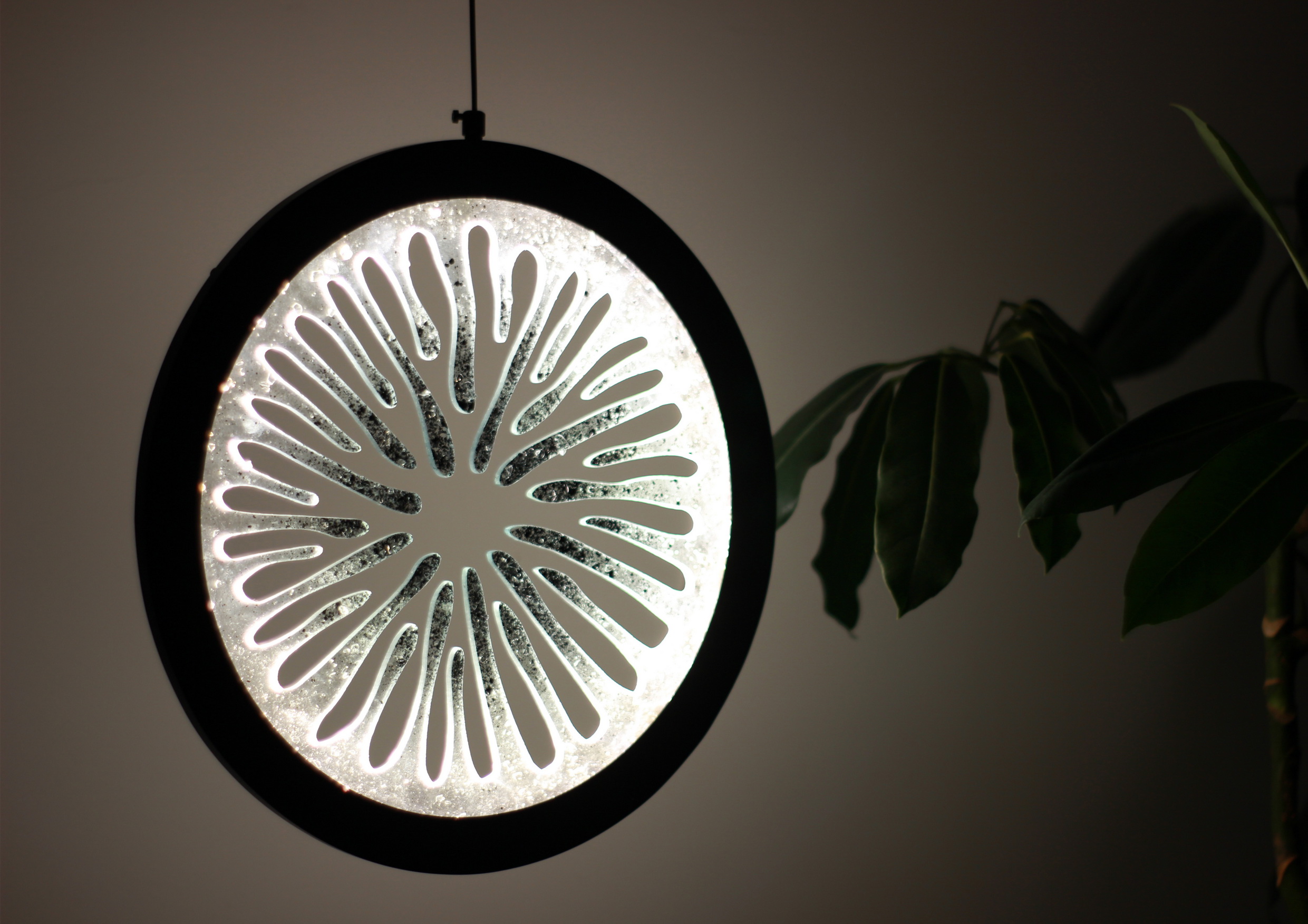
Black Eye demands precise materials. The shell is likely metal or coated aluminium for structural integrity and heat management. Diffusers or lenses (acrylic, glass, or opal) shape the light flow and obscure direct LEDs, while internal reflectors reflect and channel light. Finishes are likely dark matte or black to hide structure and emphasize luminance contrast. These material choices help the cosmic metaphor function: dark exteriors, luminous interiors, subtle transitions between light and shadow.
Prototyping challenges and how they may be handled
Common challenges for a piece like Black Eye include hotspot control, uniformity, glare mitigation, and reflection management. Early prototypes would test LED placement and diffusion geometry, measuring luminance across the surface. Reflective surfaces must avoid unwanted flare. Shell edges must hide internal optics. These issues require iterative prototypes and optical measurement equipment until effect and comfort align.
Application contexts — where Black Eye suits best
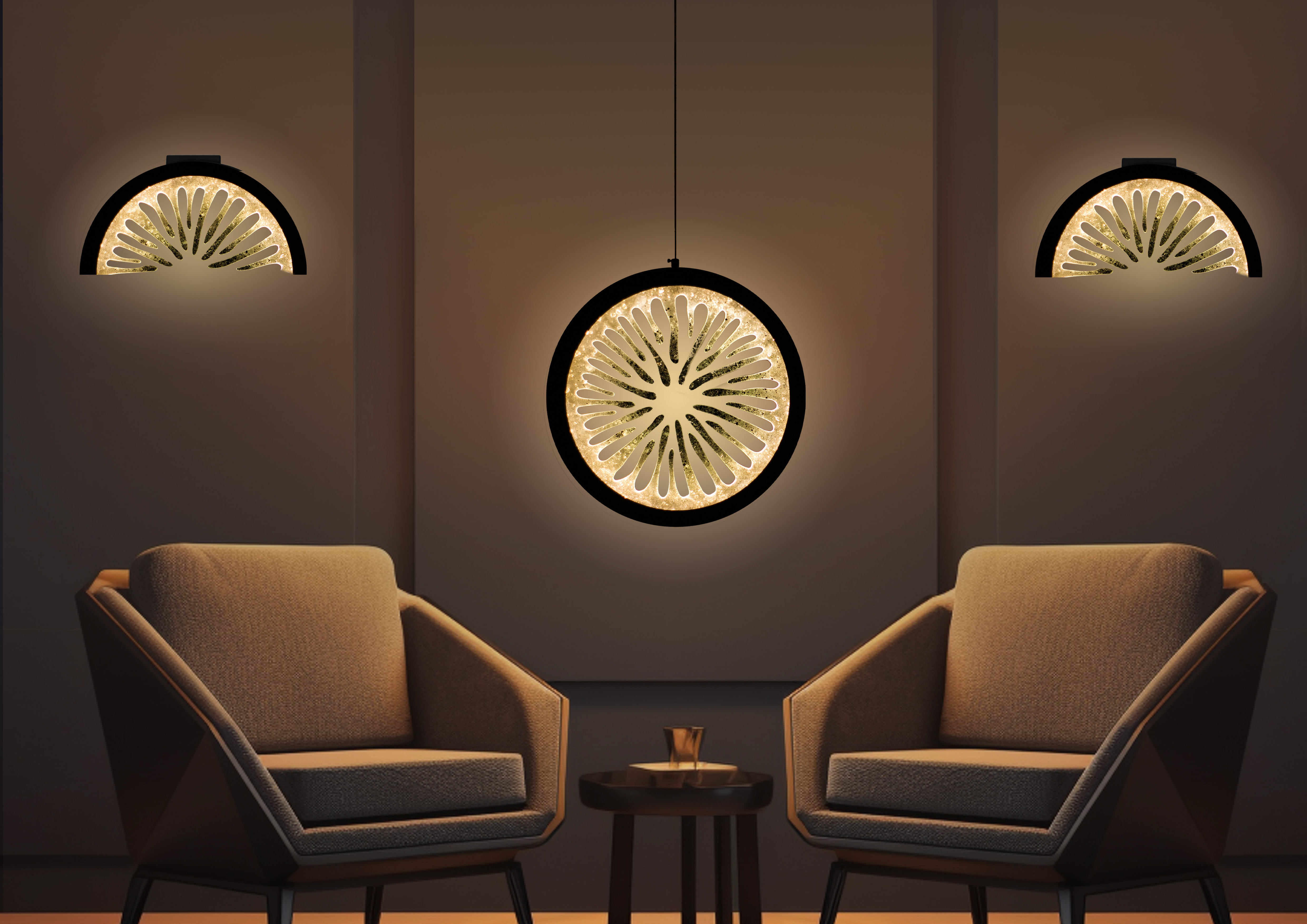
Black Eye is ideal for architectural interiors and curated spaces: lobbies, gallery interiors, upscale lounges or experiential lighting installations. Its poetic nature makes it less about broad ambient lighting and more about accent, presence and narrative. As a flagship or showpiece lamp, it can anchor zones and act as both function and conversation object.
Awards & Kioskedia recognition — what that means
Receiving Honorable Mention from Kioskedia in the Lighting Product category gives Black Eye credibility. Kioskedia tends to reward projects that balance poetic concept with manufacturability and real lighting behavior. This recognition signals to galleries, buyers and specifiers that the design is not just image but has technical merit and editorial value.
Design lessons from Black Eye — insights for creators
Start from metaphor but validate with optics early.
Use radial logic and geometry to turn poetic sketches into buildable form.
Prototype multiple times with measurement, not just visual judgement.
Choose materials that support thermal, structure and light performance.
Use awards credibly to amplify reach, but back it with real technical depth.
More information:
https://award.kioskedia.com/en/past/5